Negotiated Embodiment
When AI borrows your body, can negotiation give agency back? — a research question I'm exploring. Concept stage: no data yet, no system built.
The question
AI systems can already move human bodies. Electrical muscle stimulation (EMS) lets a computer contract your muscles directly, and recent systems pair it with vision-language models that watch a scene and decide, on their own, which of your muscles to fire. It works — but something quietly breaks in the process, and I'm not sure the field has taken that breakage seriously enough.
When a system moves your body without your intention, what exactly is lost? The instinctive answer is "it doesn't feel like my body anymore" — but that's not quite right. The body still feels like yours. Your muscles, your skin, your sense of position all keep reporting normally. What collapses is the sense of agency: the feeling this is me acting.
And agency, at its core, is an attribution problem. When your arm rises and you didn't intend it, the mind asks who did that? With no attributable answer, the experience is uncanny — this is why being actuated by an invisible force feels closer to horror than to assistance.
Ownership is a sensory problem; agency is an attribution problem. And attribution, unlike sensation, is social territory — which is where I think the interesting design space lives. Here's the question I keep coming back to: what happens if this force has a personality? If the system moving your body had a face, a voice, a life of its own — how would people react to it? Would being moved through such an agent feel more like collaboration than being moved by no one at all? And if it did — what modes of collaboration would even be possible between a person and a system that can move them?
What research has tried so far
The HCI community has been aware of the agency problem in EMS for years, and so far I count three responses — none of them social:
- Avoid it. Preemptive Action (Kasahara et al., CHI 2019) showed that if stimulation lands within a tight window after the user's own intention forms (~160 ms), the sense of agency survives. The fix is temporal, not social — it only works when the user already intended to move.
- Diagnose it. Work from the Lopes lab has located the neural signatures of agency under EMS, and in one striking study even manipulated it directly — using Bayesian optimization to tune stimulation timing until electrically-actuated movements were reported as self-caused about half the time. Agency becomes a dial you can turn, if you have millisecond-precision control.
- Exploit it. A few systems treat the loss of agency as a material property — a deliberately "possessed" hand can be a game prop, a feature rather than a bug.
The design space has been mapped: Mueller and colleagues (TOCHI 2023) describe intertwined integration along two dimensions — awareness and alignment of the machine's agency — with roles from guardian angel to adversary, and a 24-expert workshop later named "designing shared agency" among the grand challenges of computers controlling bodies.
A direction I'm considering
Here's the hypothesis I've been circling.
If agency is attribution, maybe the fix is not to restore the feeling I am acting — which the physics makes nearly impossible — but to give the involuntary movement an attributable, negotiable subject. A personified agent: one with a face, a voice, and the ability to be refused. The goal wouldn't be "my body, back under my control." It would be a shift in attribution:
Joint agency — "we did this" — is a documented state in human joint action: when two people act together, the sense of acting together coexists with, and can even strengthen, the sense of acting at all (Pacherie, 2012; Dewey, Pacherie & Knoblich, 2014). Nobody has tried to design that state into the relationship between a person and the system moving their body. That's the gap.
And within it, the variable I'd want to study isn't the agent itself — it's negotiation as a design variable. How much of it, in what form:
The counter-intuitive prediction that makes this more than a chatbot-with-electrodes: an agent that notifies but cannot be refused may be worse than no agent at all. A vague loss of control is frightening; a clear, named manipulator that politely informs you is arguably worse — it converts confusion into violation. If that prediction holds, the conclusion cuts at every "your AI assistant did this for you" product on the market: personification is not the ingredient. Negotiability is.
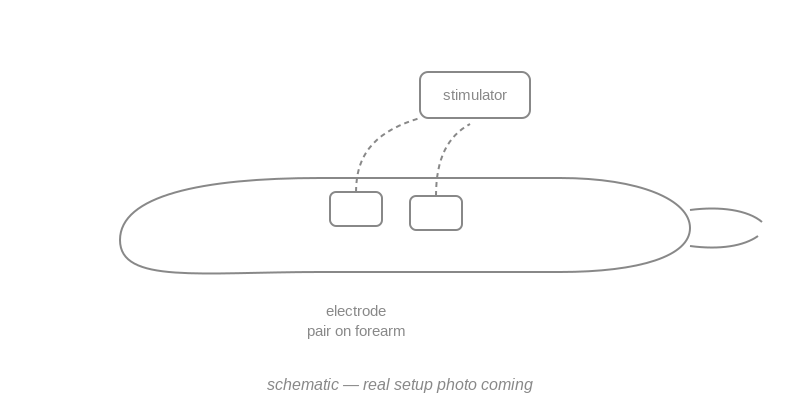
Concretely, the setup I keep sketching: real EMS on the forearm, in a real scene, with a soft, plush-like agent — present through a passthrough headset — doing the talking. A companion, not a puppeteer. (One thing I'm deliberately leaving out of scope for now: an agent that acts after being refused. That study would be about AI ethics; this one is about agency.)
Concept stage — no experimental data yet. If you work on EMS hardware, actuation timing, or the measurement of agency, I'd love to talk.