Research Vision
My broader research interest is using data efficiently to model human intent — so that systems can better understand people, and ultimately collaborate with them bidirectionally, augmenting human capability. This project is an early step: using brain signals as a channel through which a space can understand — and respond to — its occupant.
Motivation: Why This Project
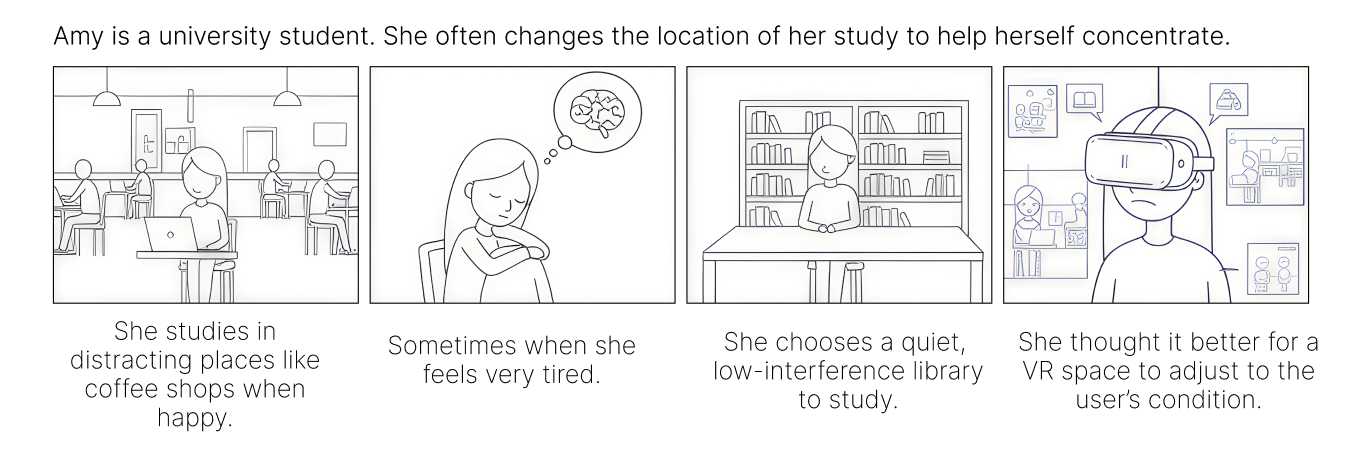
This project began with a simple observation: my study efficiency shifts dramatically with the space I am in. Sometimes I work best in a library or a café, where a moderate level of ambient distraction keeps me engaged; other times I crave a sealed, disturbance-free room where I can fully focus.
That led me to a question: could a virtual space become a responsive medium — one that senses the user's cognitive load in real time and adapts itself accordingly?
From Experience to a Variable: Openness
But "adapting itself" could mean almost anything — light, sound, and temperature are all candidate variables. So I went back to the original experience: what is actually changing between these spaces? My answer: the amount of external information entering perception. A café constantly streams stimuli in; an empty room offers almost none.
Following this thread one step further — which spatial property controls how much external information gets in? — the search converges on a single concept: openness.
Operationalizing Openness
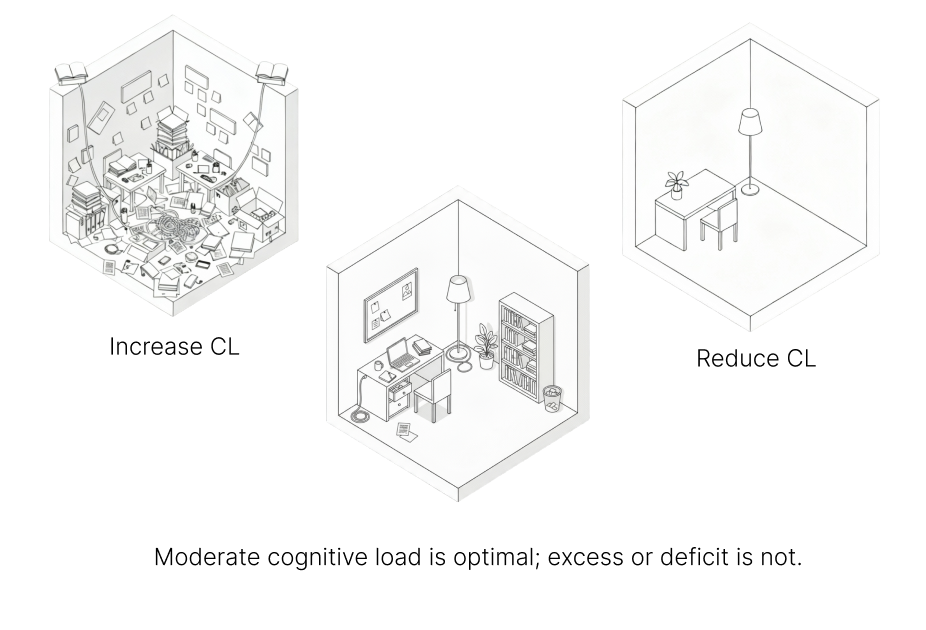
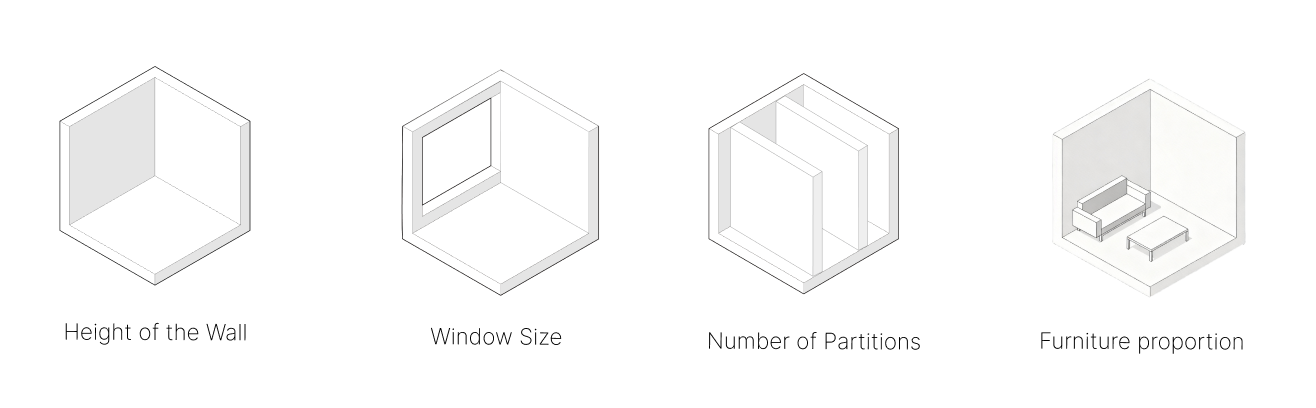
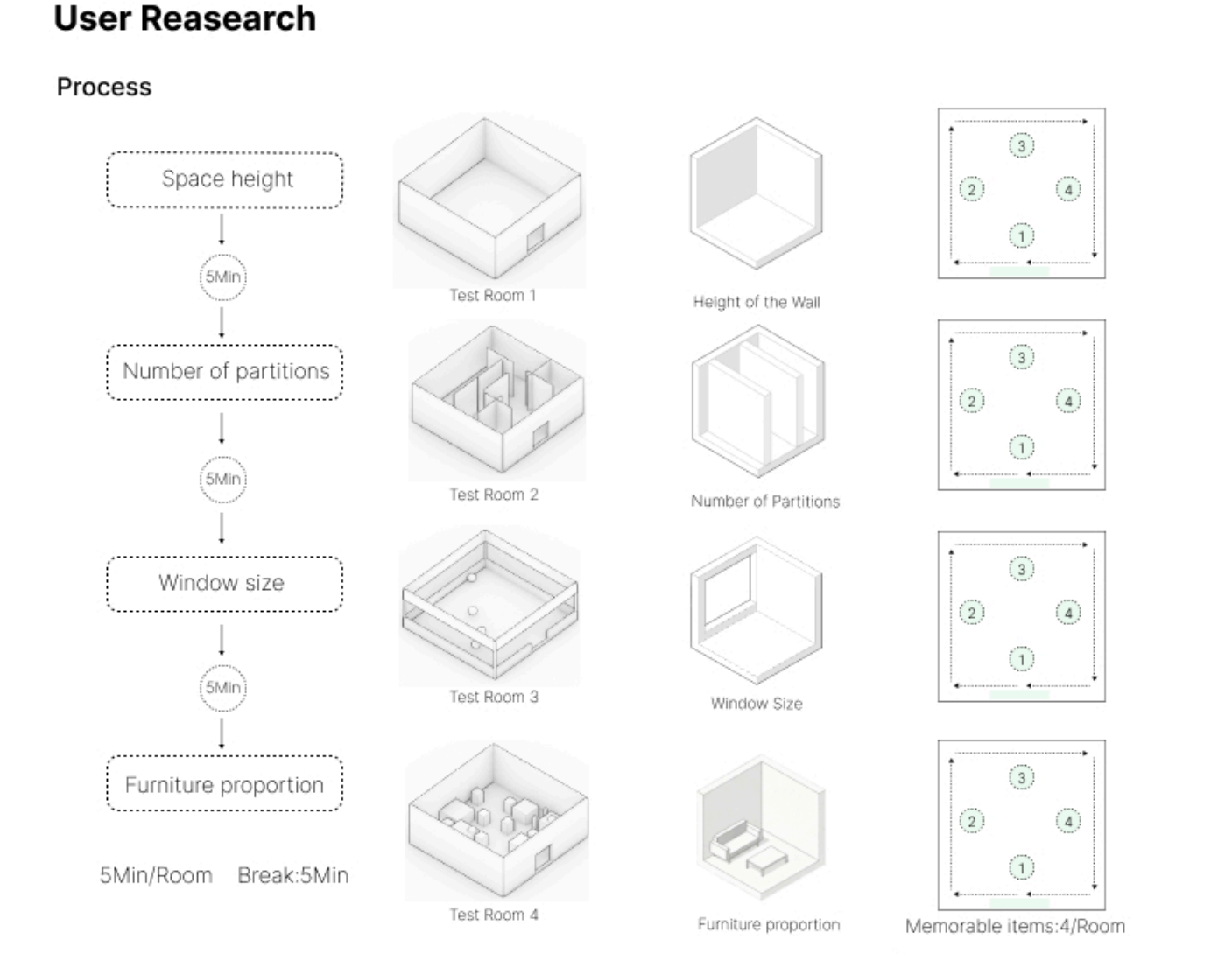
To make openness something a system can control, I decomposed it into four operable spatial variables: ceiling height, number of partitions, window size, and the furniture-to-space ratio. The open pole — high ceilings, wide windows, few partitions, little furniture — forms a visually simple room; the closed pole forms a complex, cluttered one.
The Closed-Loop System
With the four variables defined, the remaining challenge is to close the loop: sense the user, estimate their state, map that state to spatial parameters, and re-render — continuously.
Space as a Function — Grasshopper × Unity
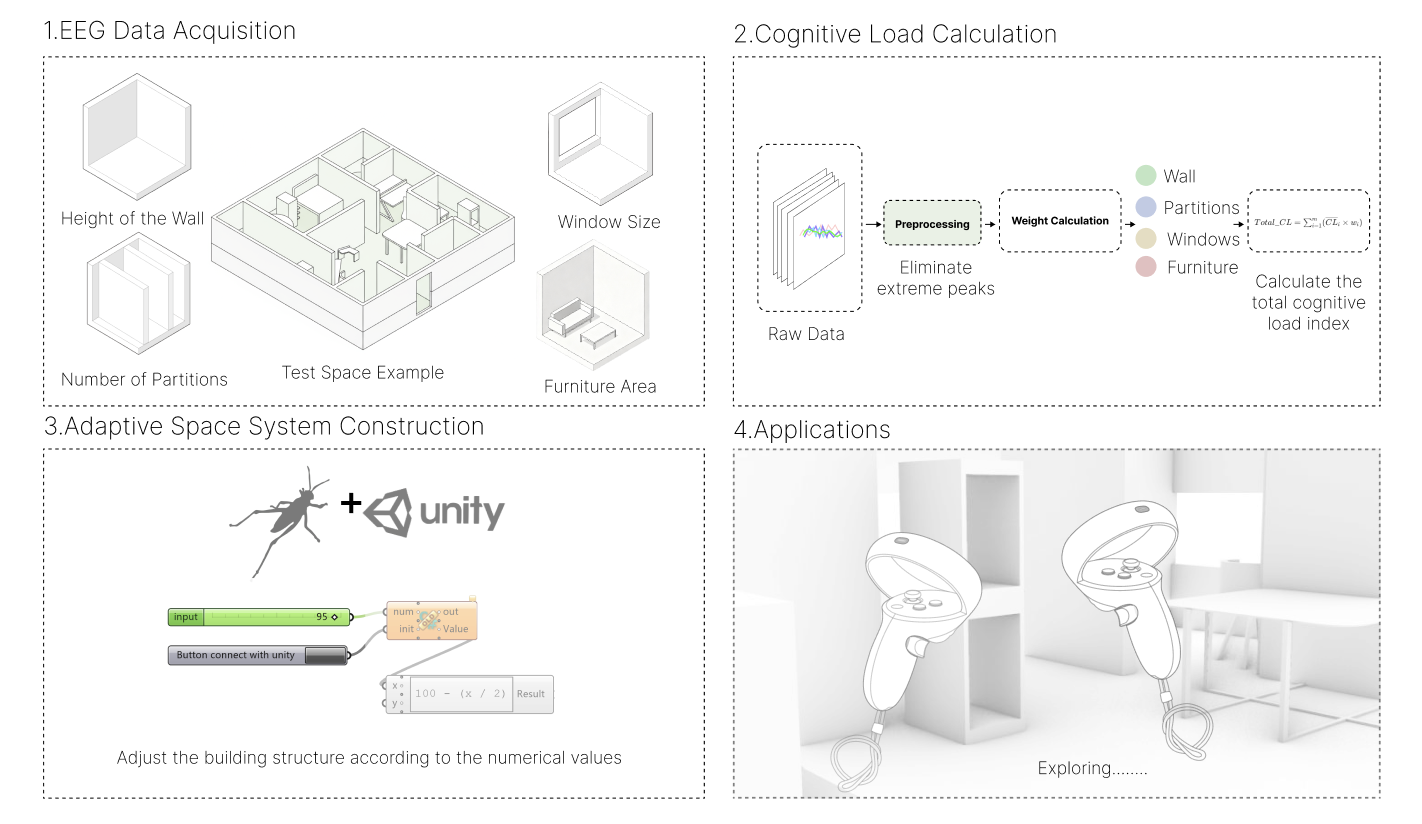
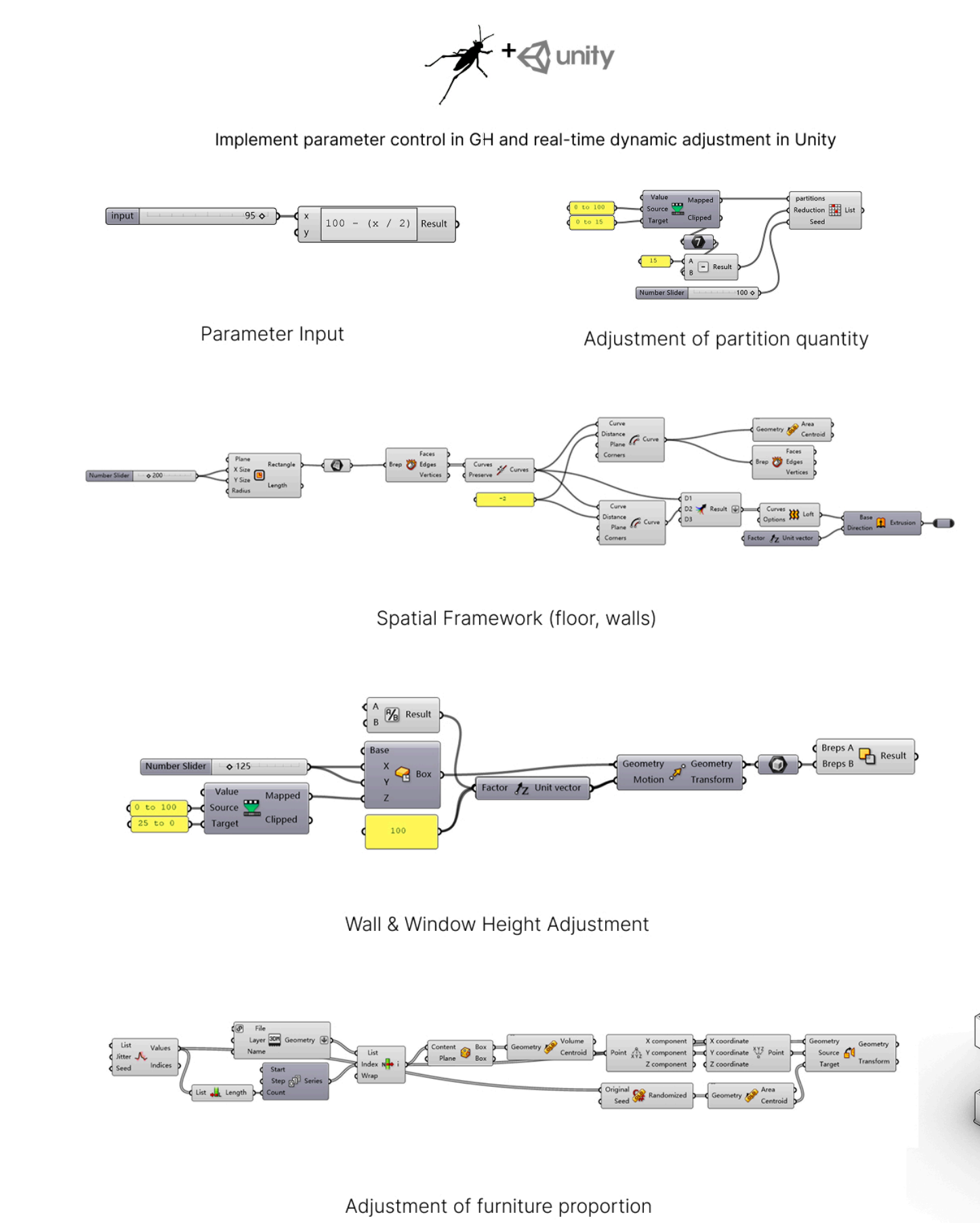
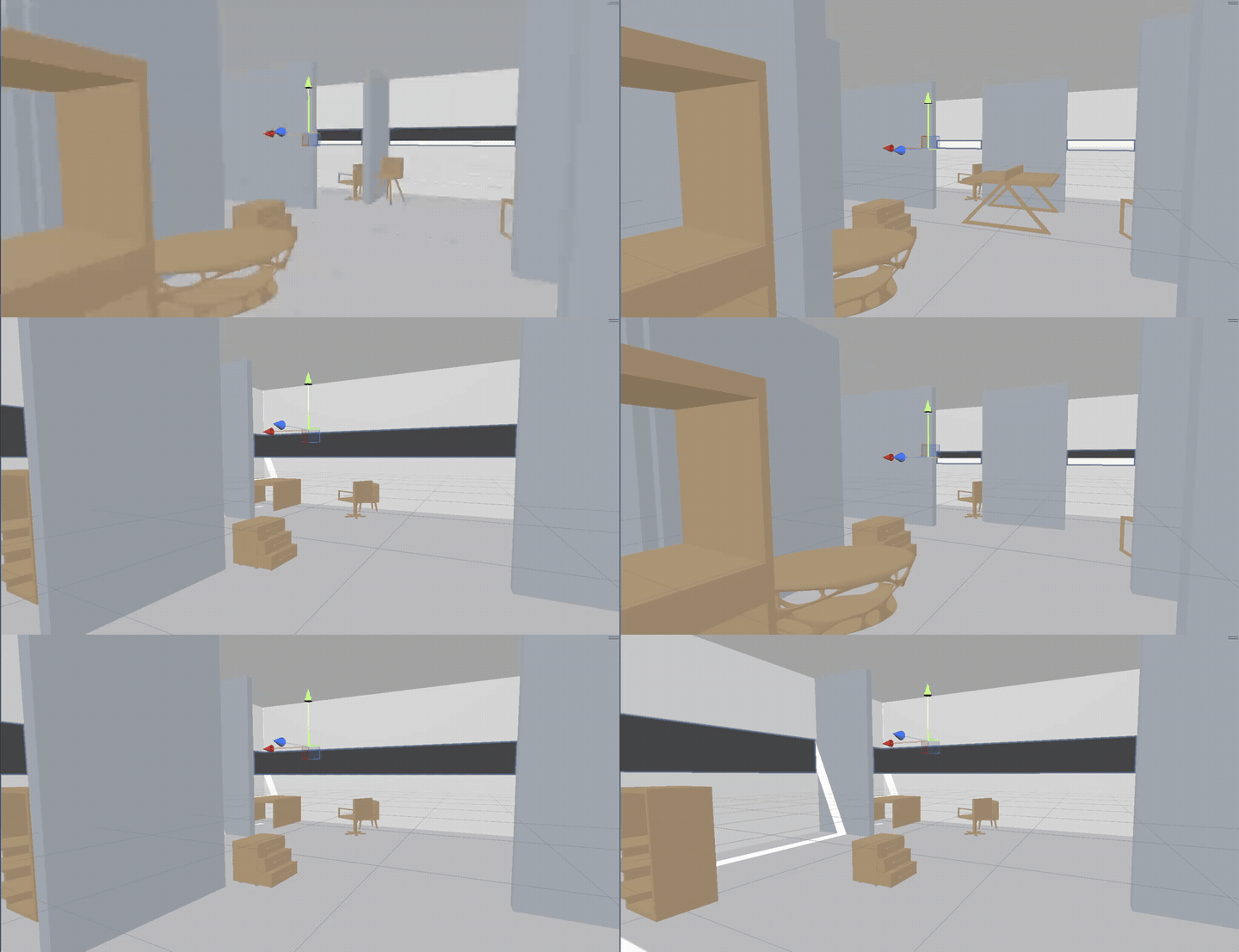
Using Grasshopper parametric modeling with Unity real-time rendering, ceiling height, partitions, windows, and furniture ratio become four numerically driven parameters. Space shifts from something designed once to something generated by a function — and can therefore be re-generated at any moment.
Sensing — Muse 2 EEG
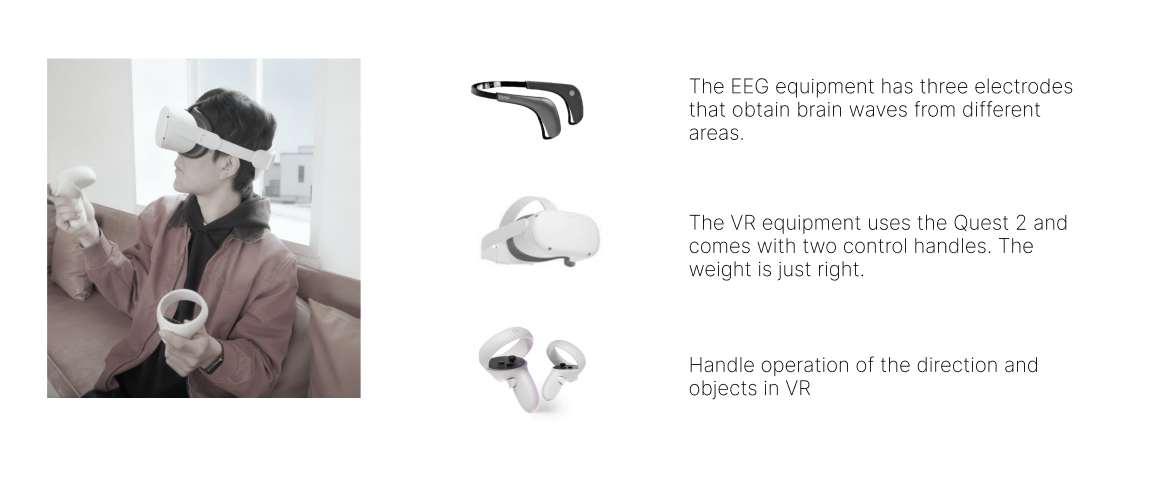
The system still needs to know when to change, and in which direction. A Muse 2 EEG headband streams the user's brain activity, from which cognitive load is estimated in real time.
Mapping — Bidirectional Regulation
The mapping logic is bidirectional, because human performance follows an inverted-U curve. When load runs too high, the space opens up — taller, brighter, less cluttered — to lower the external load; when arousal is insufficient, it grows richer and more enclosed to raise it — keeping the user in the moderate zone rather than at either extreme.
Testing & Data Collection
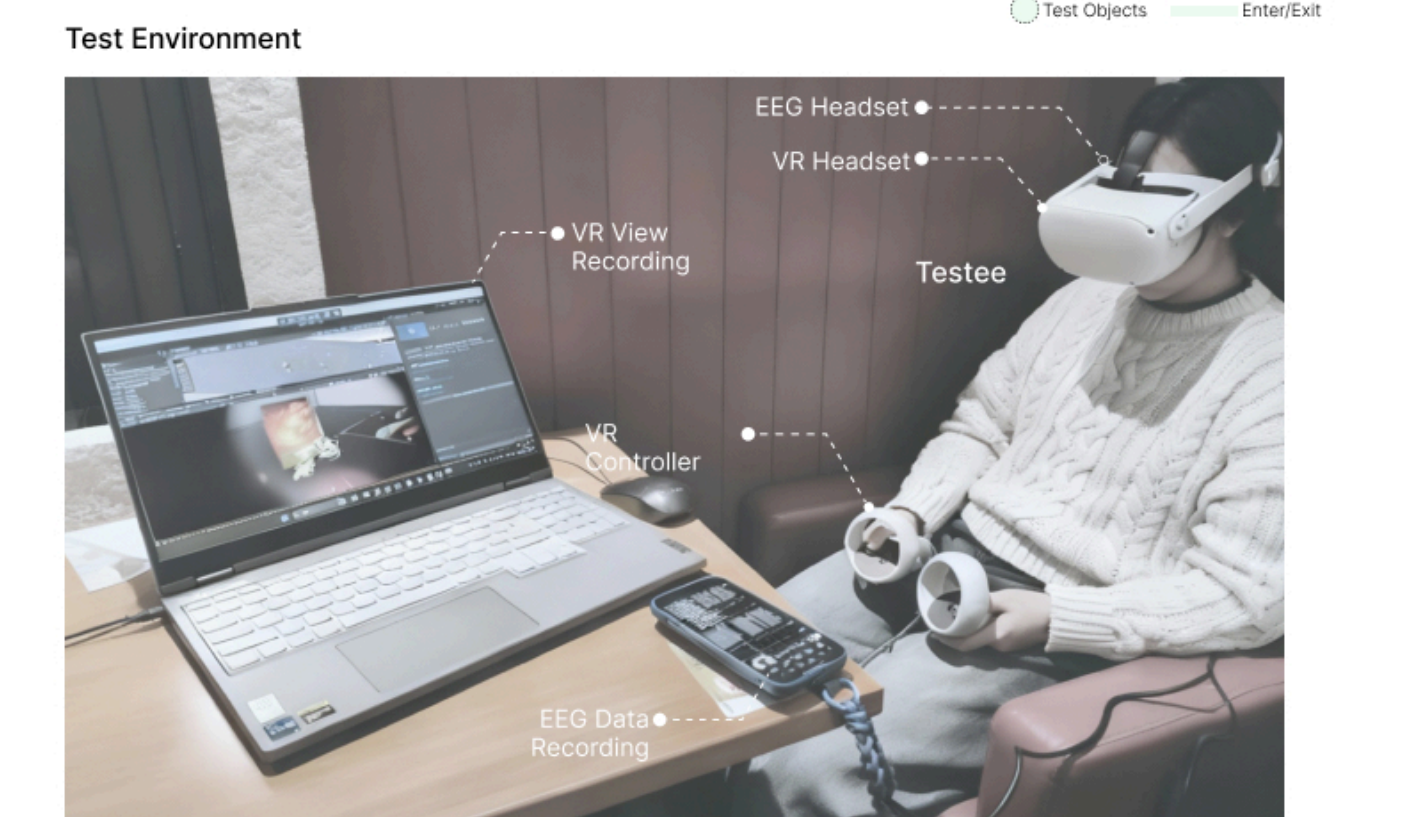
To collect data, I ran a within-subject study: 10 participants, 4 spatial conditions — one per variable — with EEG recorded throughout, so cognitive load could be estimated and compared across spaces.
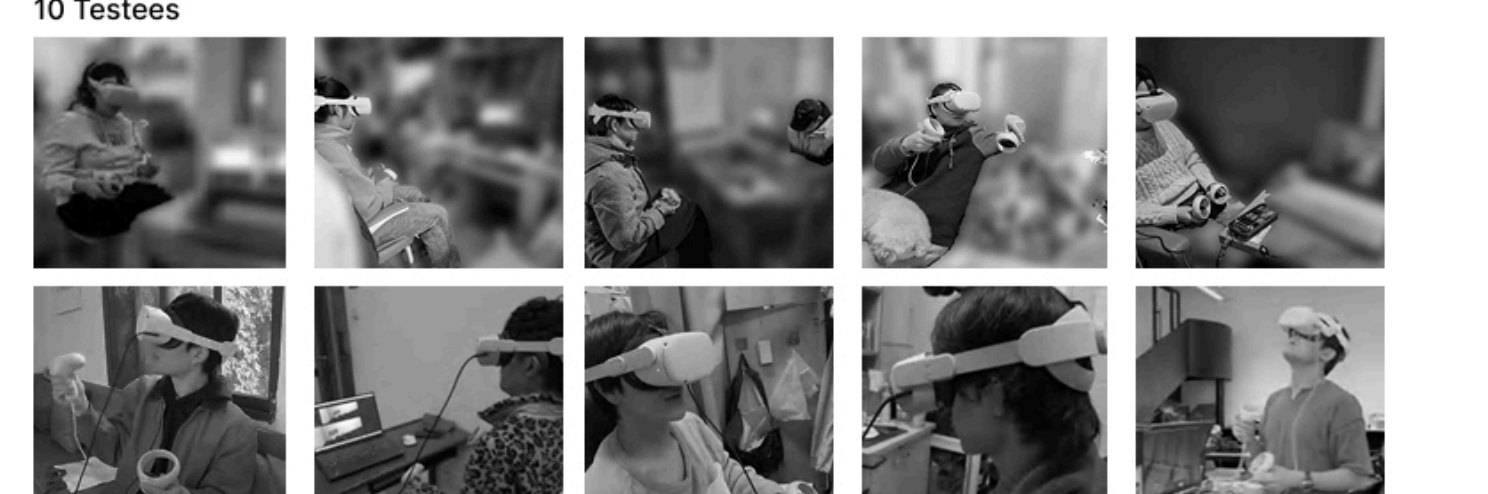
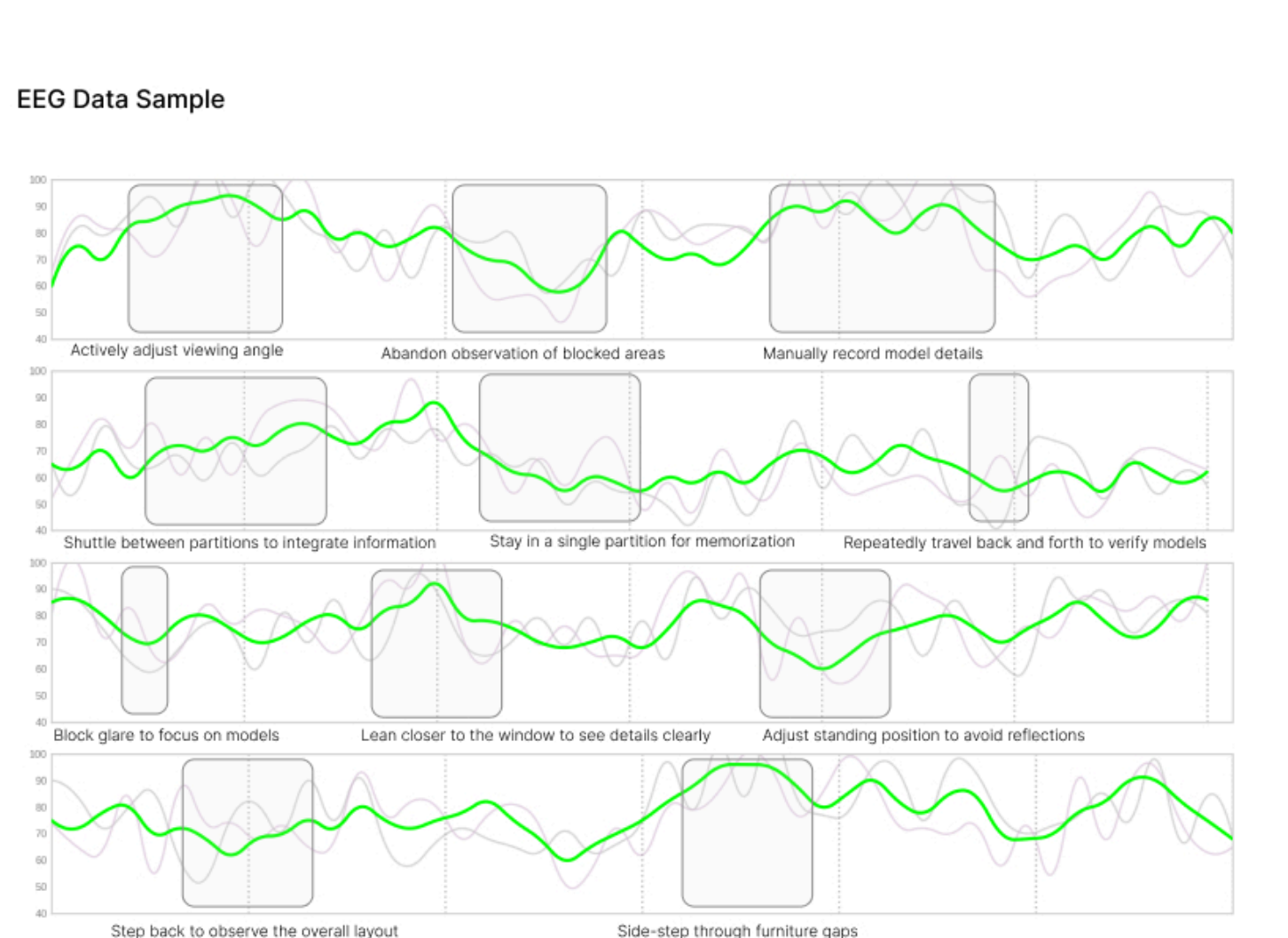
The collected EEG and the estimated load show how cognitive load tracks spatial experience across the four conditions — the empirical basis for the closed loop between brain and space.
September 2026 Update: A Revised Pipeline
In September 2026, I revisited both the cognitive-load pipeline and the study design, and rebuilt them around a stricter methodology.
The revised CL pipeline
Calibrate — one-time, per participant
An N-back task (0/1/2-back) induces three known load levels. Only EEG features that vary monotonically with the induced load — primarily the frontal θ/α ratio — are kept. This step validates the metric and sets each participant's moderate zone.
Clean and normalize
Signals are band-pass filtered, cleaned with EOG regression and artifact subspace reconstruction, then normalized to the participant's resting baseline. The old element-wise summation is dropped entirely.
Compare against the zone — then adapt
The smoothed load index is compared directly with the calibrated zone: above the zone → higher openness (taller, brighter, less cluttered); below it → lower openness (richer, more enclosed). Adjustments are rate-limited so transitions never startle.
The revised experiment
Design — three within-subject conditions
Adaptive, static, and yoked (replaying another user's adaptation trace), Latin-square counterbalanced. The yoked control isolates adaptation itself from mere spatial variety.
Sample — sized by power analysis
24–30 participants.
Reflection: beyond openness
Does openness generalize? Partly. It is one channel of a broader construct — the rate of external information reaching perception, across all modalities. Ambient noise is the same quantity in the auditory channel; lighting, crowding, and social density are others. Even stimulus count is only a proxy: a meaningful stimulus — an overheard conversation — captures attention far more than equally loud white noise. This is exactly where a closed loop earns its keep: optimal stimulation varies between individuals and moments, so no fixed space-to-load mapping can exist. The system need not be right a priori — it must be correctable. My next step is to extend the loop to a second channel, most likely the auditory one, and study cross-modal interaction.
The Adaptive Loop, Live on Quest 2
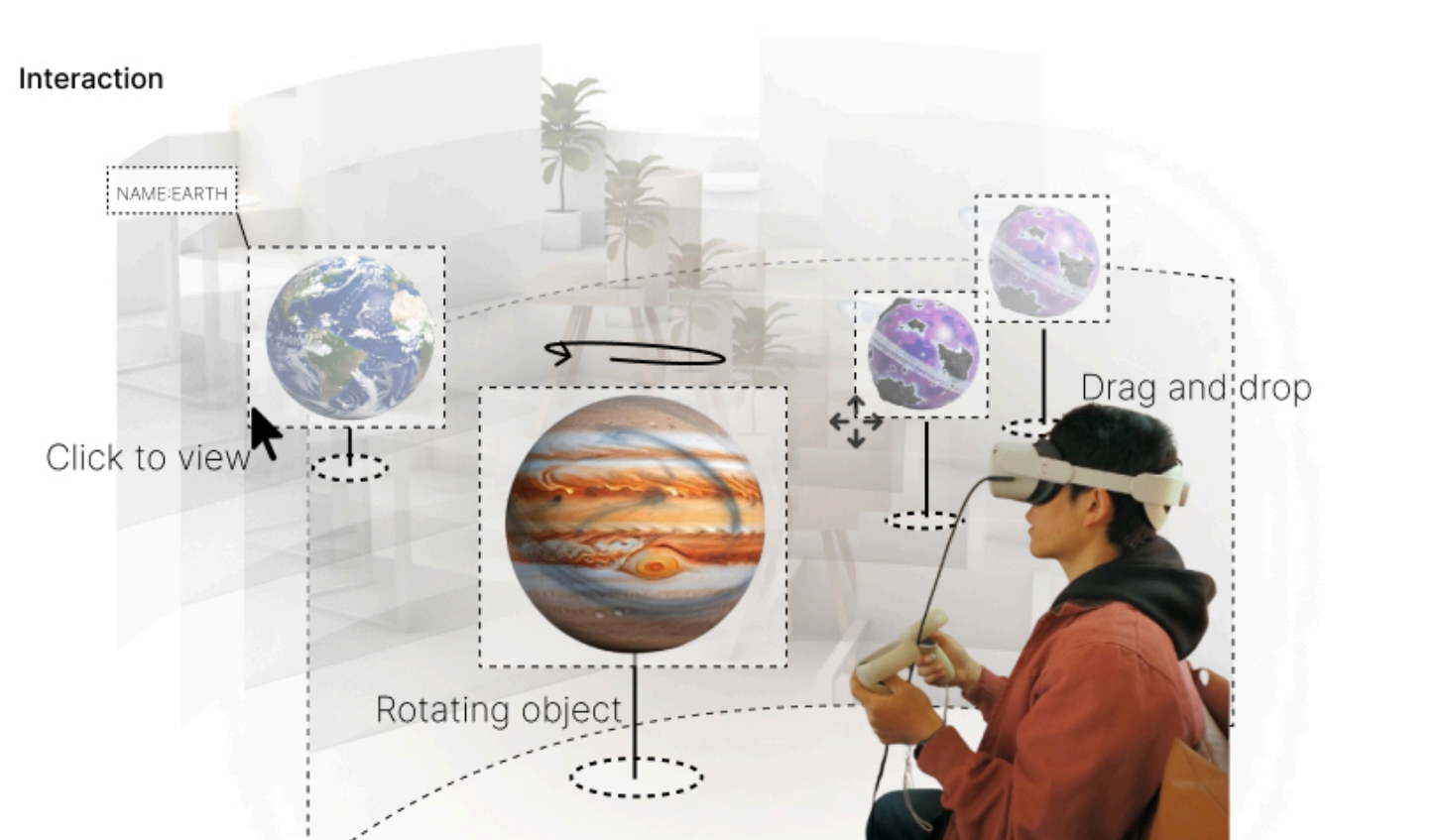
The full loop — sensing, estimation, mapping, re-rendering — runs live on a Quest 2, making the system a genuinely wearable platform rather than a desktop demo.
Takeaway
Mind-Adaptive Space treats space not as a static container but as a responsive medium that evolves with cognition — a step toward brain-responsive environments as a design paradigm for immersive learning and cognitive support, and toward systems that understand people well enough to work with them.
A question I've been thinking about lately — Nov 2026
This project keeps raising a harder question: what happens when a system stops adapting the space around you — and starts moving you instead? When AI can actuate human muscles on its own, what happens to the sense of agency — and could a negotiable, personified agent turn lost self-agency into shared agency? I wrote up where my thinking is so far here.